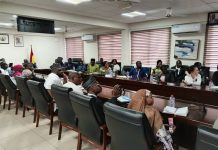

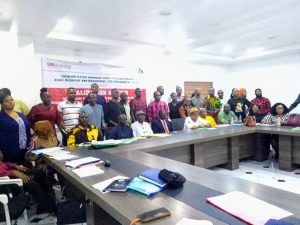
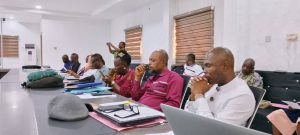
On a calm Tuesday morning in Yenagoa, representatives from government ministries, civil society groups, and community-based organizations gathered with one shared mission: to validate the data that will inform the long-awaited renovation of eight Primary Health Centres (PHCs) across Bayelsa State. Beyond the formalities, the meeting symbolized a deeper shift—one rooted in accountability, partnership, and an unwavering commitment to transforming recovered public assets into tangible community benefits.
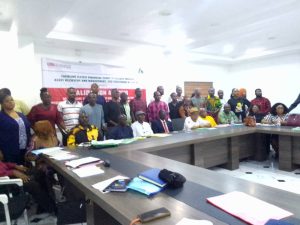
The project, funded with $954,807.40 recovered from the forfeited assets of the late former Governor DSP Diepreye Alamieyeseigha, represents one of the most closely watched public asset deployment efforts in recent years. Under the 2023 Asset Return Agreement between Nigeria and the United States, the funds were earmarked specifically for improving primary healthcare in Bayelsa, a state where many rural communities still depend on outdated or poorly maintained health facilities.
Yet, even with the funds secured, the journey has not been smooth.
From Delays to Determination
In his opening remarks, Rufai Adam of the Federal Ministry of Justice—representing the Minister of Justice, Lateef Fagbemi (SAN)—acknowledged the hurdles that had slowed the project. The initial procurement process failed to produce eligible contractors, threatening to stall progress. But with the approval of the Bureau of Public Procurement (BPP) in November 2024 and the concurrence of the U.S. Government, a refined procurement pathway emerged. It was a signal that all partners were determined not to allow administrative bottlenecks derail a project that holds life-saving potential for thousands of Bayelsans.

“This gathering is more than a formality; it is a reaffirmation of our shared commitment to ensure that the recovered assets truly serve the people,” Adam said. His words echoed the urgency felt by many in the room.
ANEEJ and BANGOF: Driving Transparency From the Ground Up
At the heart of the process is the African Network for Environment and Economic Justice (ANEEJ), an organization known for championing asset recovery transparency across Nigeria. But in Bayelsa, ANEEJ is not working alone. It has found a strong partner in the Bayelsa Non-Governmental Organisations Forum (BANGOF), the umbrella body for civil society organizations in the state.
In his welcome address, ANEEJ Executive Director, Rev. David Ugolor, emphasized the central role of civil society and local communities in ensuring that recovered funds do not disappear into bureaucratic shadows.
“Citizens want transparency, accountability, and measurable benefits,” he reminded participants. “Our goal is simple: to create a strong evidence base that will guide implementation and ensure that everyone understands what needs to change.”
This evidence was gathered through a detailed baseline assessment of the eight PHCs—an initiative birthed after ANEEJ and BANGOF co-hosted a two-day training in September for CSOs, community groups, and journalists. The training highlighted the need for a credible “BEFORE status” that would not only guide implementation but also serve as a monitoring benchmark once renovations begin.
The Power of Collective Oversight
Throughout the validation meeting, BANGOF members made their presence felt. Their participation underscored how local expertise and community ownership can strengthen accountability frameworks. Many of the forum’s representatives have firsthand experience with rural health challenges—an advantage that positions them to monitor project execution more effectively than distant observers.
BANGOF leaders commended ANEEJ for championing a transparent process and pledged to remain actively involved until the project is completed and functioning.
“We owe it to our communities to ensure that every kobo of recovered assets delivers real value,” one representative affirmed.
A New Beginning for Eight Communities
The eight selected PHCs, spread across Bayelsa’s local government areas, differ in condition—some struggling with dilapidated buildings, others lacking water, power, or basic equipment. For many of the communities, the renovation represents hope: hope for safe childbirth, timely emergency care, and a revitalized primary healthcare system.
With the validation now complete, implementation can begin in earnest.
A Model for Nigeria
The Bayelsa PHC initiative is more than a renovation project; it is a test case for how recovered assets can be used transparently and collaboratively for public good. The partnership between ANEEJ, BANGOF, government agencies, and international partners demonstrates a replicable model for other states and sectors.
If successful, the project could inspire broader confidence in asset recovery processes and showcase how communities can directly benefit from funds once lost to corruption.
A Shared Vision for the Future
As the meeting concluded, one message resonated clearly: Bayelsa communities are watching, hopeful and expectant. Through collaboration and consistent oversight, stakeholders believe this project will not only upgrade eight health centres—but also set a new benchmark for public accountability and community-driven development.
And for the first time in years, many Bayelsans can envision a future where recovered assets do not just return to government coffers—but return to the people.