


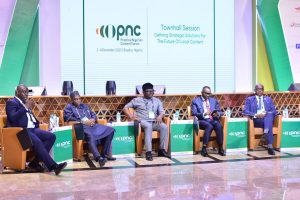
Nigeria’s oil and gas industry is entering what many observers describe as a decisive phase, as fresh local content initiatives emerge amid growing investor confidence and a renewed push for indigenous participation. This momentum was underscored at the 14th Practical Nigerian Content (PNC) Forum, where the Nigerian Content Development and Monitoring Board (NCDMB) formally launched a $100 million Equity Investment Scheme designed to strengthen the capacity of local service companies and expand the national content gains recorded over the past decade.
At the event, which drew ministers, legislators, industry leaders and senior government officials, the Executive Secretary of NCDMB, Engr. Felix Omatsola Ogbe, disclosed that Nigerian Content in the oil and gas sector had reached 61 per cent by the third quarter of 2025—an achievement that signals major progress from the era when nearly every oil-related service was imported or handled by foreign operators.
According to the NCDMB boss, the new $100 million scheme is targeted specifically at indigenous firms with high growth potential. It will provide equity financing to expand the competence of Nigerian companies participating in the energy value chain, while also serving as an instrument to diversify the Nigerian Content Development Fund (NCDF), which is funded through one-percent remittances from industry operators.
To operationalise the new scheme, a memorandum of understanding was signed between the NCDMB and the Bank of Industry (BOI), allowing BOI to manage the fund under the Nigerian Content Intervention Fund (NCI-Fund) structure. Dr. Olasupo Olusi, Managing Director of BOI, said the initiative would provide equity and quasi-equity for local companies and offer an alternative to debt financing that often limits expansion. With a $5 million single obligor limit, the programme is expected to target companies capable of scaling into competitive growth positions.
Alongside its headline funding announcements, the Board also confirmed readiness to begin onboarding a new set of Project 100 Companies—an initiative designed to identify and support 100 leading indigenous firms with targeted interventions. The first batch of Project 100 benefited from capacity programmes and market access support, and is scheduled to exit the platform by April 2026. The next batch, officials said, is expected to be larger, more innovative, and better positioned for energy transition opportunities.
Beyond funding and enterprise development, the NCDMB plans to introduce the NCDMB Technology Challenge in early 2026 and host a new Research and Development Fair later in the year. These programmes, the Executive Secretary explained, will strengthen innovation and indigenous intellectual property—areas considered vital to long-term industrial capacity in the sector. Equally significant is the Board’s completion of the framework for an NCDF Compliance Certificate, confirming adherence to one-percent remittance obligations (a long-standing requirement under the Nigerian Oil and Gas Industry Content Development Act). From January 2026, companies seeking permits or approvals from NCDMB must present this certificate.
In his remarks, Chairman of the Senate Committee on Local Content, Senator Joel Thomas, expressed concern that some companies still fail to comply with remittance rules. Legislators, he noted, would continue to support enforcement to ensure the objectives of the Local Content Act are fully achieved.
The 2025 PNC Forum also highlighted a number of recent milestones, including expanded access to financing by community contractors, with over 94 new beneficiaries recorded in 2025. The NCDMB Academy has also become a full-fledged division, organising a series of lecture programmes and skill-oriented events. In addition, the Board has begun a major training initiative focused on the top 10 oil and gas skills needed to meet rising workforce demand as final investment decisions increase on major upstream and midstream projects.
A symbolic development for Bayelsa State—and for the historical roots of Nigeria’s petroleum industry—is the start of construction of the Oloibiri Museum and Research Centre located in Otuabagi, Ogbia Local Government Area. The project, awarded in December 2024 and mobilised in July 2025, is being delivered by Julius Berger Plc and jointly funded by the PTDF, Shell (now Renaissance Africa Energy Limited), the Bayelsa State Government and the NCDMB. The facility is expected to advance energy research and commemorate the discovery of oil in commercial quantity at Oloibiri in 1956.
In separate interventions at the Forum, the Ministers of State responsible for Petroleum Resources (Gas and Oil) emphasised that Nigeria’s recent policy reforms, including the Petroleum Industry Act (PIA) and executive directives under the current administration, have restored investor confidence. Oil rigs, which once declined to 14 over the past decade, have increased significantly, with about 40 currently active. For Senator Heineken Lokpobiri, Minister of State for Petroleum Resources (Oil), this turnaround proves that Nigeria now offers globally competitive fiscal terms.
The Minister of State for Industry, Senator John Owan Enoh, said Nigeria stands on the threshold of a “transition from import dependence to production strength,” adding that the country must embrace value creation rather than just resource extraction.
Also speaking at the forum, the Special Adviser to the President on Energy, Mrs. Olu A. Verheijen, pointed to tangible results of long-term policy, noting that the transfer of onshore assets from international operators to Nigerian firms is evidence of growing domestic technical maturity. She referenced examples such as Waltersmith’s modular refinery, the Nigerian Oil and Gas Park Scheme, and the expansion of Nigerian-owned marine vessels, emphasising that “policy, ambition and capability” must continue to align.
Industry players broadly welcomed the Equity Investment Scheme, describing it as a needed step at a moment when global energy development is shifting rapidly and domestic companies must build capacity not only to service conventional oil and gas operations but also to position for cleaner and technology-driven energy futures.
Yet, while enthusiasm remains high, sector watchers caution that Nigeria’s local content progress must be matched with transparency, compliance enforcement, and a long-term strategy that spans beyond fossil fuels. With the NCDMB already reviewing key guidelines and preparing new compliance systems, stakeholders say the country may be moving into a more structured era of institutional oversight, where local content is not merely encouraged but becomes a central condition for participating in Nigeria’s energy value chain.
As the country records 61 per cent local content—a figure unimaginable two decades ago—the new $100 million equity scheme may become a defining tool for developing indigenous champions. Supporters say the initiative could mark the beginning of a cycle in which local companies no longer depend primarily on debt or foreign partnerships to participate in high-value energy projects.
For now, attention will turn to implementation. With rising foreign investment interest, major field development approvals, and new domestic financing mechanisms, the challenge will be ensuring that Nigerian companies possess the technical, managerial, and financial strength required to truly lead the country’s energy future—rather than merely participate in it.