
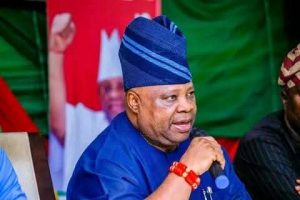
As political activities begin to gather steam ahead of the 2026 governorship election in Osun State, the conversation across political circles, communities, and civic spaces is increasingly revolving around one key question: Will Governor Ademola Adeleke secure a second term in office?
From the streets of Osogbo to the rural villages of Iwo, Ife, and Ede, discussions about Adeleke’s performance and his prospects for re-election are shaping the political atmosphere. His administration, now midway into its first term, has drawn both applause and scrutiny for its people-oriented policies, infrastructural expansion, and commitment to workers’ welfare.
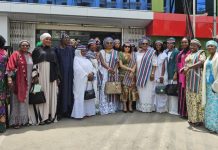
At a recent Town Hall Meet-up organized by the Ministry of Rural Development and Community Affairs in Osogbo, with the theme “Strengthening Grassroots Engagement for Sustainable Rural Development,” community stakeholders, government officials, and political leaders gathered to reflect on the Adeleke administration’s achievements and the road ahead.
Representing the governor at the event, Dr. Biyi Odunlade, Commissioner for Political Affairs, urged stakeholders to remain steadfast in their support for Adeleke’s leadership, emphasizing that continuity is crucial for sustainable progress.
> “Governor Adeleke has done well for the entire people of Osun in terms of people-oriented programmes. It is imperative for stakeholders not to rest on their oars in supporting his second-term bid,” Dr. Odunlade said.
Odunlade commended the Ministry of Rural Development and Community Affairs for creating a direct engagement platform with the grassroots, describing it as a vital step in consolidating the government’s bond with local communities. He particularly praised Aare Ganiyu Ayobami Olaoluwa, Commissioner for Rural Development and Community Affairs, and Hon. Adetunji Ajala, Senior Special Assistant on Rural Development, for their commitment to strengthening rural participation in governance.
The Grassroots Factor
The Adeleke administration’s strong focus on grassroots engagement is proving to be a key political asset. Since assuming office, Governor Adeleke has launched multiple rural infrastructure projects — from road rehabilitation and electrification to women and youth empowerment programmes — which have resonated deeply with rural voters who often feel neglected by urban-centered governance.
Aare Olaoluwa, who also served as the Chief Host of the town hall event, reaffirmed the ministry’s commitment to advancing rural development. He urged community leaders to stand solidly behind the governor’s re-election bid, noting that “in Osun State today, there is no community that Governor Adeleke’s administration has not touched.”
His statement was not mere rhetoric. From community boreholes and feeder road repairs to school renovations and agricultural support schemes, the Adeleke government’s footprint is visible in nearly every local government area. The Commissioner’s emphasis on “development people can see for themselves” speaks to a tangible approach to governance — a strategy that has earned Adeleke considerable goodwill.
Track Record and Achievements
Governor Adeleke’s tenure has been marked by several notable milestones. His administration cleared outstanding salary arrears inherited from previous governments — a move that restored trust among civil servants and retirees. Regular payment of salaries and pensions has become a hallmark of his governance, contrasting with the protracted wage crises that once plagued the state.
In the social sector, the government has launched free healthcare services across communities, improved the welfare of traditional rulers, and initiated empowerment programmes targeting women, artisans, and persons with disabilities. Infrastructure has also seen a boost, with roads, schools, and electrification projects being executed simultaneously across rural and urban centers.
“Osun has experienced rapid development under Adeleke,” Aare Olaoluwa said. “The governor’s re-election will allow him to consolidate on these gains and complete his good work for the entire people of the state.”
The Commissioner’s faith in Adeleke’s leadership is shared by many local stakeholders. Panelists at the town hall meeting drew comparisons between Adeleke’s administration and previous ones, concluding that his policies are more inclusive and welfare-driven.
Political Sentiment and Public Mood
Adeleke’s popularity remains relatively strong, bolstered by his reputation as a relatable, accessible leader. Known for his simplicity and grassroots connection, the “Dancing Senator” turned governor has successfully blended charisma with governance delivery — a combination that continues to resonate with ordinary citizens.
However, analysts caution that while public approval is high, the path to re-election is not without hurdles. Opposition parties, particularly the All Progressives Congress (APC), are expected to mount a formidable challenge in 2026. Internal party dynamics within the People’s Democratic Party (PDP) could also influence the outcome if not carefully managed.
Dr. Funsho Adebisi, a political analyst based in Osogbo, noted that Adeleke’s re-election will depend largely on maintaining unity within the PDP and deepening his reach among undecided voters.
> “Performance alone may not be enough in a politically competitive state like Osun,” Adebisi explained. “The governor must translate his developmental achievements into electoral capital by ensuring his message penetrates beyond loyal supporters.”
A Growing Coalition of Support
Despite potential challenges, Adeleke appears to be consolidating a broad coalition of support. Traditional rulers, artisans, market women, youth organizations, and local opinion leaders have consistently expressed satisfaction with his administration’s policies. The recognition bestowed on Aare Ganiyu Ayobami Olaoluwa as “Exceptional Commissioner” during the town hall event underscores a growing sentiment of appreciation toward the government’s rural agenda.
For many Osun residents, Adeleke’s second term represents continuity — an opportunity to deepen development, sustain inclusivity, and complete ongoing projects.
The Road Ahead
As the 2026 governorship election approaches, the political tempo in Osun is expected to intensify. Governor Adeleke’s challenge will be to sustain his developmental pace while navigating the political complexities that come with incumbency.
His administration’s emphasis on grassroots empowerment and transparency has laid a strong foundation. If he can maintain unity within his camp and keep delivering visible results, Adeleke’s re-election bid could become not just a political ambition but a reflection of the people’s endorsement of continuity and progress.
For now, one thing seems clear: the conversation around Osun’s 2026 election is no longer about who Adeleke is — it’s about whether Osun can afford to change the leadership trajectory midstream.
And for many stakeholders gathered in Osogbo, their answer is resounding — “Let him continue.”