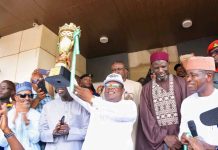

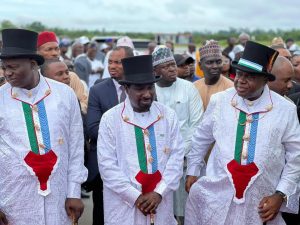
In a dramatic twist that could redefine the political contours of the South-South, Bayelsa State Governor, Senator Douye Diri, has formally joined the ruling All Progressives Congress (APC). The move, which many analysts are calling a political earthquake, was sealed on Monday at the Samson Siasia Sports Complex in Yenagoa, where Diri was officially received by Vice President Kashim Shettima on behalf of President Bola Ahmed Tinubu.
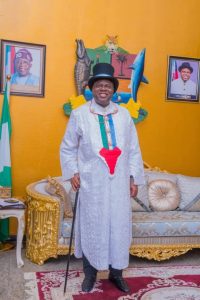
Governor Diri’s defection comes just 19 days after he resigned from the Peoples Democratic Party (PDP), ending his decades-long association with the opposition party. His switch follows similar moves by the governors of Delta, Akwa Ibom, and Enugu states—further shrinking the PDP’s control to eight states nationwide and cementing the APC’s dominance across Nigeria’s political landscape.
“An Ijaw Nation Decision”
Addressing a jubilant crowd at the ceremony, Governor Diri described his defection as more than a personal or political choice. According to him, it was “a collective step by the Ijaw nation” to align with a federal government that has demonstrated genuine commitment to development.
“This defection is not a Bayelsa defection; it is the Ijaw nation defecting to the APC,” Diri declared to thunderous applause. He explained that the decision followed “wide consultations and careful consideration,” driven by the need to safeguard Bayelsa’s developmental future and ensure continued progress.
He lamented the deep-seated internal crises within the PDP, noting that the party’s persistent divisions and leadership struggles had made meaningful reform impossible. “Over time, the unity and common purpose that once sustained the PDP eroded,” he said. “Despite our best efforts to restore it, the internal dynamics made meaningful renewal increasingly difficult.”
Federal Cooperation and Developmental Gains
Governor Diri commended President Tinubu’s leadership style, describing him as “a President who listens and acts.” He highlighted several federal initiatives that have benefited Bayelsa State, including the inclusion of the state in the Lagos-Calabar Coastal Road project, the revival of the long-delayed Nembe-Brass Road, and the federal government’s intervention in waiving excessive import taxes on Bayelsa’s 60-megawatt gas turbines.
He also applauded the approval of the Agge Deep Seaport project by the Ministry of Marine and Blue Economy, describing it as “a transformative investment for Bayelsa’s economic future.”
“These are clear demonstrations of how constructive engagement can remove obstacles to development,” he noted. “Given these actions, it was natural for us to align with leadership that acts in Bayelsa’s best interest.”
A Call for Unity and Progress
Diri assured the people of Bayelsa that his administration’s Assured Prosperity agenda would remain focused on unity, infrastructure, and inclusive growth. He dismissed suggestions that his defection was motivated by personal ambition, stressing instead that it was rooted in a desire to protect Bayelsa’s political stability and ensure sustainable development.
“Bayelsa is too small and too close-knit to be divided by partisan bitterness,” he cautioned. “Our shared heritage and future bind us more strongly than any political party.”
He pledged to work closely with APC leaders to strengthen the party in Bayelsa and support President Tinubu’s re-election bid in 2027.
Shettima: “A Homecoming for a Progressive”
Vice President Shettima, who led the APC delegation, hailed Diri’s defection as “a redemptive moment in Nigeria’s political history.” Speaking on behalf of President Tinubu, he described the governor as “a leader who has chosen the harder right over the easier wrong.”
“There are moments in the life of a nation when politics transcends partisanship—when the call to service outweighs the colours of our sentiments,” Shettima said. “Today is one of those moments.”
He praised Diri’s leadership style, describing him as “a calm and dignified leader” whose governance has been marked by development and empathy. “You have expanded roads to remote communities and assured them they are not forgotten. You have built bridges where there were barriers and brought hope where there was darkness. This is what it means to govern with empathy,” the Vice President said.
Shettima highlighted the Sagbama-Ekeremor Highway and the Yenagoa-Oporoma Bridge as examples of Diri’s tangible impact, alongside reforms in education and healthcare that have touched thousands of lives.
“Politics is about development. It is not war; it is the art of building bridges across rivers of difference,” he said, adding that Diri’s decision marked “a political reunion with a progressive mind.”
APC Gains Ground
With Diri’s defection, Bayelsa—one of Nigeria’s core oil-producing states—joins the growing list of South-South states under APC control. The development strengthens the ruling party’s influence in a region historically dominated by the PDP and signals what could be a major realignment ahead of the 2027 general elections.
As the Samson Siasia Stadium erupted in cheers and the crowd waved APC flags under the evening sky, the significance of the moment was not lost on observers. Governor Diri’s move may have begun as a political decision, but its ripple effects are likely to reshape the balance of power in the Niger Delta—and perhaps, the nation itself.