
 In the heart of New York City, far from the creeks and mangrove swamps of the Niger Delta, Bayelsa State took center stage at two high-level engagements during the 80th United Nations General Assembly (UNGA). The state, often described as the cradle of Nigeria’s oil production, came under the global spotlight not only for the environmental devastation it has endured for decades but also for the vast economic promise it holds within the strategic Gulf of Guinea region.
While one summit at the Ford Foundation headquarters amplified the cry for justice and remediation over oil pollution, another discourse at the Nigerian Mission House highlighted the state’s unique opportunities in energy, maritime security, and international trade. Together, the two events reflected Bayelsa’s paradoxical reality — a land both cursed by oil and blessed by its geography.
A Cry for Justice in New York
At the Ford Foundation headquarters in New York, the coalition known as the Just Clean-Up International Working Group (IWG) launched a passionate campaign under the theme: “Make the Polluter Pay: Environmental Genocide and Just Energy Transition.”
The summit, convened on the sidelines of UNGA, drew global attention to the findings of the Bayelsa State Oil and Environmental Commission (BSOEC) report titled “An Environmental Genocide: Counting the Human and Environmental Cost of Oil in Bayelsa, Nigeria.” The report paints a grim picture: Bayelsa, where oil was first discovered in commercial quantities in Nigeria in 1956, is more polluted today than Ogoniland — itself infamous for ecological ruin and the subject of a UN-backed clean-up.
Speakers at the event were unanimous: the time for platitudes is over; polluters must pay.
Prof. Anthony Bebbington, Ford Foundation’s Director of Natural Resources and Climate Change, cautioned against allowing energy transition and corporate divestment to become convenient escape routes for multinational oil companies. “Energy transition comes at a cost which accumulates somewhere else,” he warned. “These costs are borne by communities in places like Bayelsa, where rivers are poisoned and livelihoods destroyed.”
For Dr. Kathryn Nwajiaku-Dahou, Director of Politics and Governance at ODI Global and a member of the BSOEC, the key was accountability. “Environmental genocide is preventable if there is adequate and timely response,” she said, underscoring the IWG’s commitment to ensuring that the ten recommendations of the report are implemented nationally and internationally.
Environmentalist Dr. Nnimmo Bassey of the Health of Mother Earth Foundation (HOMEF) delivered perhaps the most chilling testimony. He described his visits to abandoned oil wells drilled in the 1950s but never decommissioned, which still leak crude into the soil. “This is why you find hydrocarbons in the blood of community people,” he lamented.
Women’s rights advocate Emem Okon narrated how oil pollution disproportionately affects women, contaminating the food chain and worsening health conditions. And King Bubaraye Dakolo, the Ibenanaowei of Ekpetiama Kingdom, accused oil multinationals of “running away” under the guise of divestment while shirking responsibility.
The event, which also featured scholars like Prof. Engobo Emeseh and activists such as Isaac Osuoka, Olanrewaju Suraj, and Alex Doukas, was not only a call to conscience but also a demand for structural redress.
Diri’s Response: A Recovery Agency
For Bayelsa’s Governor, Senator Douye Diri, the New York summit was an opportunity to reaffirm his government’s commitment to action. In a special address, he announced that the state was working with the legislature to establish the Bayelsa State Recovery Agency, backed by law, to manage a dedicated Recovery Fund.
“For decades, Bayelsa has supplied the oil and gas that powers our nation’s economy and global energy security,” Diri told the gathering. “Yet alongside this contribution has come an incalculable cost: widespread pollution, degraded farmlands, poisoned rivers, compromised health, and ruined livelihoods. Our people have endured and cried out in pain.”
He explained that the BSOEC report had been formally presented to President Bola Tinubu, who directed relevant federal ministries and agencies to act. The proposed agency, Diri said, would provide a framework for remediation and justice.
The governor expressed gratitude to the Ford Foundation, ODI, and the Just Clean-Up IWG for internationalizing Bayelsa’s plight. “We believe the pains highlighted in the report can and must be addressed through strategic partnerships,” he said. “Bayelsa cannot carry this burden alone.”
Bayelsa and the Gulf of Guinea: Promise Amid Peril
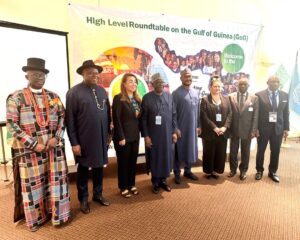
If the Ford Foundation summit focused on Bayelsa’s wounds, the High-Level Discourse on the Gulf of Guinea at Nigeria’s Mission House cast the spotlight on its opportunities. The event, themed “Unlocking Energy, Oil/Gas, Mineral Resources, Aviation and Maritime Opportunities in the Gulf of Guinea: A Roadmap for Peace and Security,” was convened by The New Diplomat in collaboration with the Angola-based Gulf of Guinea Commission.
Governor Diri’s keynote emphasized Bayelsa’s strategic position as Nigeria’s littoral state with the longest coastline — over 200 kilometers — on the Atlantic. “The Gulf of Guinea is one of the world’s most strategic maritime basins,” he said. “It anchors nearly 60 percent of Africa’s oil production, holds 4.5 percent of global proven oil reserves, and supports a vast market of over 500 million people across West and Central Africa.”
From fisheries and coastal tourism to oil exports and maritime logistics, Bayelsa, Diri argued, is positioned as both an energy powerhouse and custodian of fragile ecosystems. But opportunities, he acknowledged, come with risks.
Piracy, illicit financial flows, and organized crime remain pressing threats in the Gulf. To tackle these, the governor outlined his administration’s community-based crime prevention strategy, backed by partnerships with the Nigerian Navy, Police, and international bodies like the United Nations Office on Drugs and Crime (UNODC) and Germany. He cited the successful rescue of seven kidnapped victims in 2022 as evidence of progress.
Global Stakeholders Weigh In
The discourse also featured global voices. Ambassador Ghada Waly, UNODC’s Executive Director, stressed that insecurity in the Gulf undermines trade, energy flows, and governance. “Over $40 billion has been lost in the last decade through illicit financial flows and embezzlement,” she said, warning that unchecked corruption enables criminal networks to infiltrate supply chains.
Oma Djebah, convener and Director of The New Diplomat, announced plans for a Gulf of Guinea Business Council (GoGBC) to deepen collaboration between governments, private sector actors, and development partners. Former UN Under-Secretary-General Prof. Ibrahim Gambari, who chaired the session, echoed the need for pragmatic partnerships to unlock the region’s potential.
The Bayelsa Paradox
Juxtaposed, the two summits underscore Bayelsa’s paradox: a state rich in oil, gas, and maritime assets yet scarred by pollution and underdevelopment. The challenge for leaders like Governor Diri is to reconcile these extremes — to demand justice for past harms while opening doors to sustainable opportunities.
For communities in the creeks, the hope is that internationalizing their plight will translate into tangible clean-up, compensation, and safer livelihoods. For investors eyeing the Gulf of Guinea, the message is that Bayelsa is open for business — but on terms that balance prosperity with responsibility.
The Ford Foundation event gave voice to the pain of the people, while the Gulf of Guinea discourse spotlighted their promise. Together, they point toward a future in which Bayelsa is not just the face of oil pollution but also a hub of innovation, trade, and ecological renewal.
Conclusion
As the dust settles on the UN General Assembly, Bayelsa’s dual narrative — of wounds and wonders — remains alive. For Governor Douye Diri, the task is steep: to heal a land ravaged by decades of neglect while positioning it as a gateway to regional prosperity.
Whether through the proposed Recovery Agency or through maritime partnerships in the Gulf of Guinea, Bayelsa’s story is now firmly on the global stage. The world is watching, and the people of Bayelsa are waiting — for justice, for recovery, and for the dawn of shared prosperity.