

 By Our Reporter
The Bayelsa Non-Governmental Organisations’ Forum (BANGOF) has emphasized the critical role of effective report writing and documentation in strengthening the impact and credibility of civil society organizations (CSOs) and non-governmental organizations (NGOs).
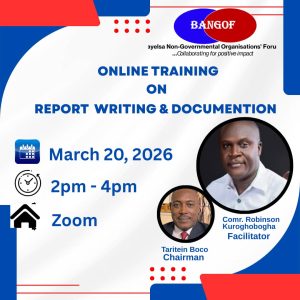
The training, held virtually on March 20, 2026, via Zoom, brought together participants from across the sector for a two-hour session focused on improving reporting standards and documentation practices. The session was facilitated by Comrade Robinson Kuroghobogha, while the Chairman of BANGOF, Taritein Boco, provided leadership and guidance.
Speaking during the training, Kuroghobogha highlighted that “report writing is not just a routine task but a strategic tool that determines an organization’s credibility and access to funding.” He stressed that donors rely heavily on well-structured reports to assess performance, transparency, and accountability.
He further outlined key ethical considerations in reporting, including confidentiality, integrity, and strict adherence to donor requirements. “Organizations must avoid data manipulation and ensure consistency, clarity, and simplicity in their reports,” he said.
The session also underscored the importance of documentation as the backbone of reporting. According to the facilitator, documentation involves the systematic recording, organizing, and management of information related to organizational activities. “Without proper documentation, effective reporting becomes impossible,” Kuroghobogha noted.
Participants were introduced to the core characteristics of good documentation, including accuracy, completeness, timeliness, organization, and security. Practical tools such as Microsoft Word, Excel, and data collection platforms like KoboCollect were recommended to enhance efficiency.
In his remarks, Chairman Taritein Boco encouraged organizations to prioritize documentation at every stage of their activities. “Events and programs must be properly documented, from attendance sheets to financial records and meeting minutes. This is what builds institutional memory and strengthens accountability,” he said.
The training also highlighted common reporting mistakes that organizations should avoid. These include listing activities without demonstrating impact, inconsistencies between narratives and data, poor record-keeping, and late submission of reports.
“Such mistakes can damage an organization’s reputation, raise questions about data integrity, and reduce donor confidence,” Kuroghobogha warned. He added that balanced reporting—capturing achievements, challenges, lessons learned, and corrective actions—is essential for credibility.
BANGOF reiterated that donors are increasingly interested in understanding not just what organizations do, but how they operate and regulate themselves. “Good reporting drives both funding and impact,” Boco concluded.
The training forms part of BANGOF’s ongoing efforts to build the capacity of NGOs and promote best practices in the development sector.