
[contact-form][contact-field label=”Name” type=”name” required=”true” /][contact-field label=”Email” type=”email” required=”true” /][contact-field label=”Website” type=”url” /][contact-field label=”Message” type=”textarea” /][/contact-form]
[contact-form][contact-field label=”Name” type=”name” required=”true” /][contact-field label=”Email” type=”email” required=”true” /][contact-field label=”Website” type=”url” /][contact-field label=”Message” type=”textarea” /][/contact-form]
[contact-form][contact-field label=”Name” type=”name” required=”true” /][contact-field label=”Email” type=”email” required=”true” /][contact-field label=”Website” type=”url” /][contact-field label=”Message” type=”textarea” /][/contact-form]
By Our Reporter
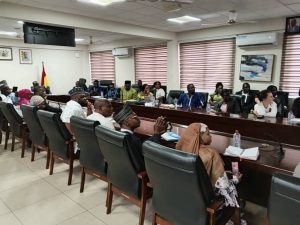 Nigeria has taken another decisive step toward confronting the persistent challenge of out-of-school children, as the Executive Secretary of the National Commission for Almajiri and Out-of-School Children’s Education (NCAOOSCE), Dr. Muhammad Sani Idris, led a high-level Nigerian delegation on a courtesy visit to Ghana’s Ministry of Education. The visit was held under the ongoing Nigeria–Ghana Learning Exchange on Complementary Basic Education, a bilateral initiative aimed at strengthening inclusive education systems across West Africa.
The Nigerian delegation was received by Professor George Oduro, Technical Adviser to Ghana’s Minister of Education, Hon. Haruna Idrissu. The engagement provided an opportunity for both countries to review progress, share lessons, and explore practical pathways for reducing the number of children excluded from basic education, particularly among vulnerable and marginalized populations.
At the heart of the Learning Exchange is a shared recognition that Nigeria and Ghana face similar socio-economic and cultural realities that contribute to school exclusion, including poverty, migration, child labour, and socio-religious practices. However, Ghana’s long-term investments in Complementary Basic Education (CBE), backed by strong community participation and progressive policy reforms, have produced encouraging outcomes in enrolling and retaining out-of-school children. These gains, stakeholders noted, offer valuable insights for regional adaptation and scale-up.
Speaking during the engagement, Dr. Idris emphasized Nigeria’s commitment to learning from proven models while tailoring solutions to local contexts. He noted that addressing the out-of-school crisis requires more than infrastructure alone, stressing the importance of community ownership, flexible learning models, and cross-sector collaboration. According to him, the Learning Exchange provides a practical platform to translate policy dialogue into action, particularly for children affected by displacement, poverty, and informal education pathways.
Professor Oduro, in his remarks, underscored the importance of peer learning among African countries confronting similar education challenges. He highlighted Ghana’s experience with Complementary Basic Education as evidence that non-formal and flexible learning approaches can successfully bridge gaps for children who have missed out on conventional schooling. He also called for sustained political will and funding to ensure that such initiatives are institutionalized and expanded.
The exchange, facilitated and funded by the British High Commissions in Nigeria and Ghana, convened key education stakeholders from both countries, including policymakers, technical experts, and development partners. Participants shared practical strategies, implementation lessons, and scalable solutions for advancing inclusive and equitable basic education, with a focus on reaching the hardest-to-reach children.
Beyond knowledge sharing, the engagement reinforced the value of regional cooperation in achieving global education goals. By deepening collaboration and aligning complementary efforts, Nigeria and Ghana aim to accelerate progress toward reducing out-of-school numbers and ensuring that every child, regardless of background, has access to quality basic education.
As the Learning Exchange continues, stakeholders express optimism that lessons drawn from Ghana’s experience will inform Nigeria’s ongoing reforms, strengthen community-based education models, and ultimately contribute to a more inclusive education landscape across the region.