

 By Rhoda Godwin
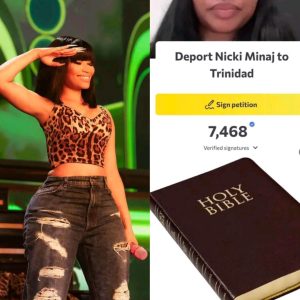
A fresh wave of online controversy has trailed global rap star Nicki Minaj following reports that more than 7,400 people have signed a petition calling for her deportation from the United States to her country of origin, Trinidad and Tobago.
The petition, which has gained traction across social media platforms, emerged in response to comments she reportedly made on religion and gender issues, triggering widespread criticism and renewed debate about celebrity speech and accountability.
According to reports circulating online, the backlash began after Minaj publicly spoke about her religious beliefs and shared opinions on gender-related topics. While some fans viewed her remarks as personal expressions of faith and conviction, others interpreted them as divisive, arguing that they could be harmful to certain communities. The disagreement quickly escalated from online debate into organized digital protest.
What Nicki Minaj Said About Religion
At the center of the controversy are Minaj’s comments about her Christian faith and religious freedom. The artist has spoken openly about reconnecting with God and described her faith as an important influence in her life. In public remarks and online posts, she emphasized that people should be free to practice their religion without fear of persecution.
Minaj also highlighted what she described as the persecution of Christians in different parts of the world, calling for greater global attention to religious violence. She framed her statements as advocacy for religious freedom and human rights, rather than as criticism of other belief systems. However, critics argue that her comments appeared selective and politically charged, particularly because they were made alongside broader social and political commentary.
Some observers felt the remarks elevated one religious narrative over others or were used to support exclusionary views, especially when discussed in the same space as sensitive gender topics. These interpretations intensified the backlash and contributed to the calls for boycotts and unfollows.
Petition and Public Reaction
Petitions demanding deportation, though largely symbolic, have become a common form of online activism. Legal experts note that such petitions rarely lead to actual immigration consequences, especially for individuals who are long-term residents or citizens, but they often serve as a public expression of dissatisfaction.
In Minaj’s case, social media users claim that many fans have unfollowed her in protest, expressing disappointment and accusing the rapper of using her platform irresponsibly. Others have come to her defense, arguing that she is being unfairly targeted for expressing her beliefs and warning against what they describe as “cancel culture.”
Broader Implications
Born in Trinidad and Tobago and raised in the United States, Nicki Minaj has long been known for her outspoken personality and polarizing presence in pop culture. This latest episode underscores the growing tension between freedom of expression and public accountability, particularly for influential figures whose words can shape public discourse.
As of the time of this report, Minaj has not issued an official response to the petition or the reported loss of followers. Whether the controversy will have lasting implications for her career remains to be seen, but it has once again placed her at the center of a global conversation about religion, identity, and the power of online movements in shaping public opinion.