
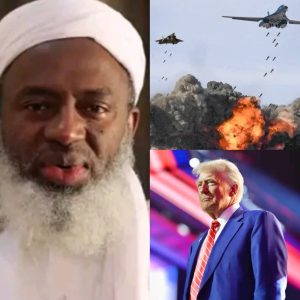
Abuja — Fresh controversy has erupted across Nigeria following claims that the country played a key behind-the-scenes role in recent United States airstrikes allegedly carried out on Nigerian soil, raising questions about sovereignty, transparency, and the future of foreign military partnerships.
The debate intensified after prominent Islamic cleric, Sheikh Ahmad Gumi, publicly urged the Federal Government to immediately halt all military cooperation with the United States. Gumi warned that foreign military involvement, particularly by the U.S., could turn Nigeria into a theater of war and deepen internal divisions.
According to the cleric, counterterrorism operations led or supported by foreign powers often result in the deaths of innocent civilians and are driven by hidden geopolitical interests rather than genuine concern for local security. He further argued that framing military action around the protection of specific religious groups could dangerously polarize Nigeria’s multi-religious society.
“No nation should allow its land to become a theater of war, and no nation should allow its neighbors to be its enemies,” Gumi said, adding that Nigeria could seek military assistance from countries such as China, Turkey, or Pakistan if needed.
Alleged Nigerian Involvement
Fueling the controversy are reports suggesting that Nigeria was not taken by surprise by the U.S. action. According to emerging details attributed to the Minister of Foreign Affairs, Yusuf Tuggar, Nigerian authorities reportedly provided critical intelligence ahead of the strike.
The reports claim that the Nigerian government held two direct conversations with U.S. Secretary of State Marco Rubio — one approximately 19 minutes before the strike, and another just five minutes before it was executed. If confirmed, this would indicate a high level of coordination and consent rather than unilateral U.S. action.
These revelations have sparked intense reactions across the country, with many Nigerians questioning why such a significant security decision was not publicly disclosed or debated beforehand.
Public Reactions Split
Public opinion remains sharply divided. Some Nigerians argue that intelligence cooperation with international partners is necessary to combat terrorism and protect national security. Others believe that foreign military involvement, especially by the United States, could invite retaliation from extremist groups and undermine Nigeria’s sovereignty.
Civil society groups and analysts are also calling for greater transparency from the government, urging officials to clearly explain the nature, scope, and legal framework of any foreign military cooperation.
As of press time, the Federal Government has not issued a detailed public statement directly confirming or denying the timing and content of the alleged calls with U.S. officials.
Bigger Questions Ahead
The unfolding situation raises broader questions about Nigeria’s counterterrorism strategy, its alliances, and the balance between security cooperation and national autonomy. With tensions high and public scrutiny growing, observers say the government may be forced to clarify its position to prevent further mistrust and speculation.
For now, Nigerians continue to ask: Was the country an active partner in the operation, or was it drawn into a global security decision with far-reaching consequences?