
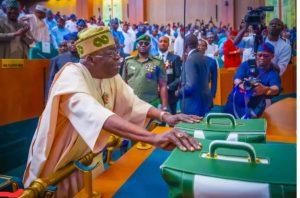
 President Bola Ahmed Tinubu on Friday presented a ₦58.47 trillion Appropriation Bill for the 2026 fiscal year to a joint session of the National Assembly, with defence and security emerging as the largest sectoral allocation at ₦5.41 trillion.
The proposed budget, titled “Budget of Consolidation, Renewed Resilience and Shared Prosperity,” is aimed at strengthening macroeconomic stability, deepening reforms, and translating recent economic gains into inclusive growth and improved living standards for Nigerians.
According to the President, total projected expenditure for 2026 stands at ₦58.18 trillion, while expected revenue is ₦34.33 trillion. The budget deficit of ₦23.85 trillion represents 4.28 per cent of the nation’s Gross Domestic Product (GDP). Debt servicing is estimated at ₦15.52 trillion, while recurrent (non-debt) expenditure is pegged at ₦15.25 trillion. Capital expenditure is projected at ₦26.08 trillion.
The 2026 budget assumptions include a crude oil benchmark of 64.85 dollars per barrel, daily oil production of 1.84 million barrels, and an exchange rate of ₦1,400 to the US dollar.
In sectoral allocations, defence and security received the highest share with ₦5.41 trillion, reflecting the administration’s focus on tackling terrorism, banditry, kidnapping, and other violent crimes. Infrastructure followed with ₦3.56 trillion, while education and health were allocated ₦3.52 trillion and ₦2.48 trillion respectively.
Addressing lawmakers, President Tinubu said the budget builds on reforms implemented over the past two and a half years, noting that while the reforms had brought hardship, they were necessary to stabilise the economy and rebuild confidence.
He cited recent economic indicators as evidence of progress, including a 3.98 per cent GDP growth in the third quarter of 2025, moderation in inflation for eight consecutive months to 14.45 per cent in November 2025, improved oil production, growth in non-oil revenues, and external reserves rising to about 47 billion dollars — a seven-year high.
The President acknowledged challenges in the implementation of the 2025 budget, particularly in capital releases, but assured that 2026 would witness stricter fiscal discipline. He disclosed that directives had been issued to key economic officials to ensure full implementation of the 2026 budget in line with approved timelines.
On revenue mobilisation, Tinubu said the government would rely on the new National Tax Acts, oil and gas sector reforms, and full digitisation of revenue collection by government-owned enterprises to reduce leakages and improve transparency.
In the area of national security, the President announced plans to modernise the armed forces, enhance intelligence-driven policing, strengthen border surveillance, and introduce a new national counter-terrorism doctrine. He warned that all armed non-state actors operating outside state authority would be treated as terrorists.
On human capital development, Tinubu highlighted expanded access to education through the Nigerian Education Loan Fund, which has supported over 788,000 students. He also noted increased healthcare investment and announced over 500 million dollars in anticipated support from international partners for health interventions.
The budget also prioritises agriculture, food security, and infrastructure development, with plans to strengthen mechanisation, irrigation, storage, and agro-value chains to boost productivity and job creation.
President Tinubu urged lawmakers to support the budget, stressing that its success would depend not on announcements but on effective delivery, accountability, and measurable outcomes.
“I lay before this distinguished Joint Session the 2026 Appropriation Bill of the Federal Republic of Nigeria and seek your partnership in charting the nation’s fiscal course for the coming year,” he said.