
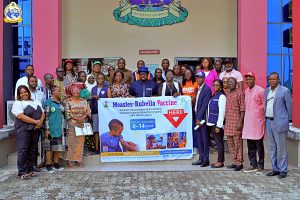
Bayelsa State primary health care board yesterday inaugurated the Advocacy Communication and Social Mobilization (ACSM) Technical Working Group (TWG) at the BHIS Conference Hall, marking a significant step in strengthening community engagement and improving public awareness ahead of the Measles-Rubella (MR) vaccine introduction.
The meeting, chaired by Dr. Williams Appah, brought together health experts, partners, civil society groups, government agencies, and community structures to harmonize communication strategies for disease prevention.
Dr. Appah, who formally inaugurated the group, emphasized that effective communication and coordinated advocacy are essential to achieving high vaccination coverage and protecting communities, especially vulnerable groups such as children and pregnant women.
Key highlights of the meeting included a presentation by Dr. Malachi Ogeleni., Consultant with the International Vaccine Access Center, who outlined critical facts about Rubella and its dangers when contracted during pregnancy. He explained that Rubella—though milder than measles—poses a serious threat to unborn children through Congenital Rubella Syndrome (CRS), a preventable condition that can cause lifelong disabilities including blindness, deafness, heart defects, and brain damage. He stressed that CRS remains a major health burden in areas with low vaccination coverage, calling for intensified community education and vaccine advocacy.
Dr. Malachi further announced the upcoming nationwide introduction of the combined Measles-Rubella vaccine, which will replace the current measles-only vaccine. From 20–29 January 2026, children aged 9 months to 14 years will be eligible to receive the MR vaccine during the campaign. After the campaign, the vaccine will be administered routinely at 9 and 15 months. He clarified that children who previously received the measles vaccine must still take the MR vaccine, reinforcing the need for maximum protection.
Also speaking, Dr.Makio Perekeme, Health/SBC Consultant for MR Bayelsa State, emphasized the urgent need for robust awareness creation, community engagement, and partner coordination to ensure the success of the MR campaign. He noted that the ACSM TWG would provide central support for communication activities at national, state, and LGA levels to eliminate fragmentation in messaging.
The objectives of the ACSM initiative include enhancing strategic behavior change communication, improving media outreach, strengthening digital communication, and building staff capacity in evidence-based advocacy. The governance structure involves multiple government MDAs, development partners such as UNICEF and WHO, civil society organizations, traditional institutions, religious leaders, and youth groups.
Among the organizations inaugurated into the TWG were the Community Based Organizations (CBO), Bayelsa Nongovernmental forum, (BANGOF), Nigerian Association of Women Journalist, (NAWOJ), Christian Association of Nigeria, (CAN), Eunice Nnachi Women Advocacy Foundation (ENWAF) and the Women Organized for Mentorship and Advocacy Network (WOMAN), all recognized for their strong grassroots presence and commitment to women-led community advocacy.
The newly formed TWG is expected to drive coordinated messaging, improve social mobilization, deepen community trust, and support Bayelsa State’s efforts to eliminate measles and rubella, ultimately strengthening public health outcomes for children and families.