
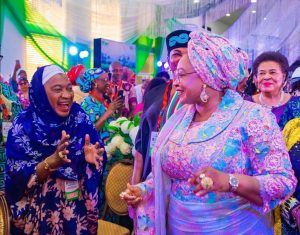
Benin City, Edo State — Against the backdrop of Edo’s regal palaces and the deep cultural roots of the region, the 25th National Council on Women Affairs and Child Development convened under what is perhaps the most vital of themes: “Strengthening Systems & Deepening Social Impact: Advancing the Renewed Hope Social Agenda for Women, Children, the Family & Vulnerable Groups.” This annual gathering, organized by the Federal Ministry of Women Affairs and Social Development, offered a powerful lens into the vision and momentum of Minister Hajiya Imaan Sulaiman-Ibrahim, and her commitment to reimagining gender and social policy in Nigeria.
A Council of Purpose and Possibility
The council, held from November 9 to 14, drew commissioners for women affairs from all 36 states and the FCT, together with civil society actors, development partners, and grassroots champions. As the apex policy-making forum for women and child development, the gathering served not merely to deliberate but to chart a deliberate course for future impact.
Dr. Maryam Keshinro, Permanent Secretary of the Ministry, speaking at the technical session, underscored that this council remains “a veritable avenue … to measure progress … and address emerging issues in the sector.” Her remarks echoed the Ministry’s commitment to evidence-based policy and enhanced institutional frameworks.
Leadership with Vision and Compassion
Minister Imaan Sulaiman-Ibrahim’s presence and messaging at the event were imbued with purpose. In her opening address, she championed accountability, cross-sector collaboration, and investments that lift women and families not just in rhetoric but in real, measurable ways. She painted a future where social systems are not fragmented, but integrated — a future aligned with the Renewed Hope Agenda of President Bola Ahmed Tinubu.
Her leadership, attendees observed, combines humility with results. As noted by the special adviser on media, “her ability to translate policy into measurable social impact has earned her respect within and outside government circles.”
Deepening Social Impact: The Programs in Focus
Central to the Ministry’s strategy is a bold set of Renewed Hope Social Impact Interventions, known by the acronym RH-SII 774. As President Tinubu highlighted during a launch, these are not piecemeal efforts — they are a unified, gender-responsive platform to reach the most marginalized.
The program has four key components:
- WAVE (Women Agro-Value Expansion): Targeting 5 million women smallholder farmers, WAVE seeks to transform Nigeria’s agricultural value chain by offering capacity building, market access, and tools to create wealth from the land.
- Power Her Up 774: An ambitious effort to provide 1,000 solar home systems per local government — enabling women to power their homes, sustain businesses, and bring energy access into the heart of communities.
- Clean Cooking Programme: Addressing a major health risk, this initiative promotes safer fuels like LPG and solar cookstoves, while helping households transition away from firewood.
- Women’s Economic Empowerment Programme: Small business owners are supported with seed funding, training, and mentorship — a launchpad for sustainable entrepreneurship.
If fully realized, RH-SII 774 is expected to impact over 50 million women, children, families, and vulnerable persons across all 774 local government areas.
Building Financial Agency: Voices from the Field
At the Council, Kathleen Erhimu, founder of Kudimata Nigeria, used her platform to call for stronger partnerships to deepen women’s financial inclusion. She praised Minister Imaan for steering the Ministry toward impact, not just talk.
Erhimu highlighted that her organization has trained more than 1.4 million women and youth in financial literacy and business management — including 250,000 through their “EmpowerHER” initiative. Her plea was clear: when women are financially stable, families become stronger, communities safer, and societies more prosperous.
Anchoring Social Inclusion with Resources
The Ministry’s aim is reinforced not just by vision but by substance. Earlier this year, it secured the first major budget increase in 30 years. Minister Imaan has made clear that this boost must go beyond optics: part of the investment will revive the National Electronic Dashboard for Gender-Based Violence (GBV) to strengthen data-driven response; expand skills training; and scale up child protection systems.
A Call for Action and Unity
At the closing of the Conference, Edo State Governor Senator Monday Okpebholo, represented by his deputy, urged women to see dignity not as a slogan but as their rightful inheritance, calling for unity, purpose, and policy coherence.
The Minister, too, reflected on the gravity of the platform. She noted that the Council drives the integration of gender perspectives into decision-making, ensuring that the voices of women and children are heard and acted upon.
Beyond the Council: A Broader Landscape
The work of the Ministry stretches far beyond Benin City. Under Minister Imaan, the Nigeria for Women Project (NFWP) — a major women economic empowerment platform — has mobilized over 460,000 women into affinity groups, which collectively saved billions in internally generated funds. Thousands have received grants, skills training, and access to financial institutions, national IDs, and health insurance.
The broader vision is audacious, yet concrete: not arms-length interventions, but sustainable, national systems that transform lives at scale.
Challenges & Opportunities Ahead
Yet, the path is not without hurdles. Institutional coordination across 36 states, entrenched power dynamics, and the sheer scale of ambition pose formidable challenges. The Council itself acknowledged this, calling for renewed commitment and collective accountability.
But the tone from Benin City was hopeful. With leadership that is both bold and grounded, a funding roadmap, and engaged partners, the Ministry appears poised to deliver on its mandate.
Conclusion
At the heart of Nigeria’s quest for progress lies its families — and perhaps no ministry is as strategically placed to strengthen that foundation than the Federal Ministry of Women Affairs and Social Development. Under Hajiya Imaan Sulaiman-Ibrahim, the Ministry is not just talking about inclusion and empowerment; it is building systems to make them real.
The 25th National Council in Benin City was more than a meeting — it was a declaration of intent. If the agenda set there is followed with rigor, collaboration, and transparency, the impact could ripple far: brighter opportunities for women, safer homes for children, and stronger social fabric for the nation.