

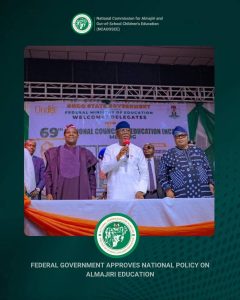
In a landmark decision at the 2025 National Council on Education (NCE) meeting in Akure, Ondo State, the Federal Government of Nigeria has officially approved the National Policy on Almajiri Education, marking a major milestone in the nation’s quest for inclusive and equitable education.
The new policy, designed and driven by the National Commission for Almajiri and Out-of-School Children Education (NCAOOSCE) under the leadership of Dr. Muhammad Sani Idris, aims to integrate millions of Almajiri children into Nigeria’s formal education system for the first time in history.
According to Dr. Idris, the approval of the policy represents “a turning point in Nigeria’s educational narrative,” as it ensures that no child is left behind, regardless of socio-cultural or religious background.
The Federal Ministry of Education, led by the Honourable Ministers Dr. Moruf Tunji Alausa and Professor Suwaibah Sa’id Ahmad, facilitated the policy’s adoption in line with the Renewed Hope Agenda of President Bola Ahmed Tinubu, GCFR, which emphasizes education as a cornerstone for national development.
With the new policy, the Almajiri child will no longer be considered out-of-school. The Federal Government has redefined the nation’s education framework by officially recognizing the Almajiri learning system—previously viewed as marginally non-formal—as part of the national education structure.
Key provisions of the policy include:
Harmonization of curricula across Tsangaya schools;
Integration of literacy, numeracy, critical thinking, and vocational skills;
Enhanced teacher training, incentives, and supervision;
Improved funding mechanisms;
Proper learner documentation and parental engagement; and
Minimum standards for infrastructure and WASH (Water, Sanitation, and Hygiene).
Dr. Idris commended all stakeholders who contributed to the success of the policy, particularly the Foreign, Commonwealth & Development Office (FCDO) – PLANE, and other development partners whose technical and financial support were crucial.
“This historic approval is proof that through strategic leadership, collaboration, and persistence, inclusive education can become a reality,” he stated.
The new framework promises to transform traditional Almajiri schools into structured learning environments, fostering literacy, empowerment, and national cohesion.
With this policy, the Federal Government has signaled a new era where every Nigerian child—regardless of origin—has the right and opportunity to be educated, empowered, and included.