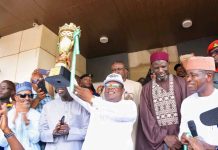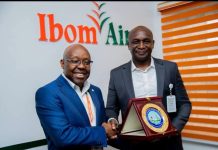


The air inside the Ernest Ikoli Press Centre Hall of the Nigeria Union of Journalists (NUJ), Bayelsa State Council, was thick with admiration, applause, and deep reflection. It was the closing ceremony of the 2025 NUJ Press Week — a celebration not just of journalism, but of vision, resilience, and the enduring role of the media in promoting justice, accountability, and development in Nigeria.
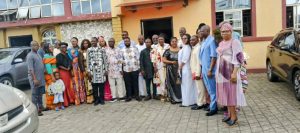 This year’s Press Week, themed “Media, Social Justice and National Development,” resonated powerfully with both journalists and policymakers, as it underscored the press’s moral and civic responsibility in shaping governance and sustaining democracy. The event also provided an opportunity to honour individuals who have distinguished themselves in public service — notably Bayelsa State Governor, Senator Douye Diri, who was honoured with the Iconic Achiever Award for his administration’s outstanding contributions to infrastructural development across the state.
A Governor Honoured for Visible Transformation.
Governor Diri’s recognition by the NUJ was more than ceremonial — it symbolized the union’s acknowledgment of tangible progress in the state’s infrastructural and socio-economic landscape. Represented by Dr. Kolawole Oredipe, the Director-General of Bayelsa Government New Media, the governor expressed gratitude to the union for the honour and reaffirmed his administration’s commitment to inclusive growth.
“This honour is well deserved for a leader who has demonstrated great dedication to building a new Bayelsa State,” Dr. Oredipe said to a round of applause. “There is no argument as to whether this government is performing or not. The projects are tangible and visible from the East to the West and Central Senatorial Districts.”
Oredipe further praised the partnership between the government and the media, describing it as essential for the success of the Prosperity Administration’s developmental agenda. He assured that Governor Diri would continue to work closely with journalists in promoting transparency, accountability, and citizen engagement in governance.
Under Diri’s leadership, Bayelsa State has witnessed an infrastructural renaissance — with improved road networks, health facilities, educational institutions, and youth development initiatives such as the Prosperity Cup, which has become a model for grassroots sports empowerment in the Niger Delta.
For the NUJ, these achievements reflect a broader narrative — that of governance working hand-in-hand with the media to advance the collective good.
 NUJ Reaffirms Commitment to Responsible Journalism
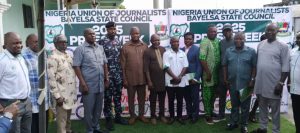
In his welcome address, the Bayelsa NUJ Chairman, Comrade Tonye Yemoleigha, struck a reflective tone, describing the 2025 Press Week as a milestone for the State Council. He noted that it was the first Press Week under the current executive, which was elected in November 2024, and highlighted the union’s landmark achievements within a short period.
Among these was the historic Bayelsa Media Summit, the first of its kind in the over 70-year history of the NUJ in Nigeria — a forum that brought together scholars, practitioners, and policymakers to deliberate on the evolving role of the media in national development.
“Our success story cannot be told without the unwavering support of the state government and our partners,” Yemoleigha said. “The NUJ will continue to uphold the principles of responsible journalism and foster collaboration for the common good of society.”
He also expressed appreciation to key stakeholders including Governor Diri, his Deputy, the Commissioner for Information, Orientation and Strategy, Hon. (Mrs.) Ebiuwou Koku-Obiyai, the Speaker of the State House of Assembly, High Chief Abraham Ingobere, and the Niger Delta Development Commission (NDDC) for their continuous partnership.
The Chairman announced other award recipients, among them Hon. Oforji Oboku, Member Representing Yenagoa/Kolokuma/Opokuma Federal Constituency; Hon. Daniel Charles, Member Representing Brass Constituency 1; and the State Commissioner of Police, CP Francis Idu, recognized for their service to governance, public safety, and community development.
Revisiting Africa’s Founding Ideals Through the Media Lens
At the intellectual core of the 2025 NUJ Press Week was a keynote presentation by Dr. John Kalama, an erudite scholar and media advocate, who delivered a stirring lecture on “Media, Social Justice, and National Development.”
Dr. Kalama began with a sweeping historical reflection, tracing Africa’s journey from the era of visionary leaders like Kwame Nkrumah of Ghana, Jomo Kenyatta of Kenya, and Sekou Touré of Guinea, whose dreams of unity, equity, and justice inspired the creation of the Organization of African Unity (OAU), now the African Union (AU).
He lamented that while these leaders envisioned a peaceful, progressive Africa, the post-independence era witnessed reversals caused by neo-colonial interference, internal greed, and political instability — factors that derailed the continent’s march toward genuine freedom and development.
In this context, Dr. Kalama argued, the media remains central to Africa’s quest for justice and progress. From the nationalist press of the 1940s and 1950s — led by figures like Nnamdi Azikiwe, Ernest Ikoli, and Casely Hayford — to today’s digital platforms, the African media has evolved from a tool of liberation to an instrument of accountability and reform.
“Today’s journalists inherit a noble legacy,” Dr. Kalama declared. “They must rise to their professional calling as agenda setters, watchdogs, and nation builders. The media, when it operates freely, ethically, and responsibly, becomes an indispensable partner in achieving social justice and national development.”
He emphasized that a free and ethical press enlightens the citizenry, amplifies marginalized voices, and holds leaders accountable — functions essential for building peace, equality, and national cohesion.
The Media as a Catalyst for Justice and Development
Dr. Kalama’s paper offered a compelling comparative reflection on pre- and post-independence Africa, noting the transformation of the media from “rudimentary communication tools” to modern platforms shaping governance and civic participation.
He likened journalists to moral compasses and defenders of the weak, whose work, even in times of conflict, deserves protection under international conventions — much like humanitarian workers of the Red Cross.
The paper concluded with a call to action: for the African media to continue to speak truth to power, nurture democratic values, and uphold its sacred duty as the conscience of the nation.
Pathways Forward: Strengthening the Fourth Estate
In his recommendations, Dr. Kalama outlined practical measures for enhancing media impact in Nigeria and Africa. These included:
Strengthening media independence and freedom of expression to protect citizens and journalists from intimidation or unlawful arrest.
Promoting ethical journalism and fact-checking, ensuring that only trained professionals are licensed to practice.
Investing in media literacy to empower citizens to understand and engage constructively with public policy.
Encouraging collaboration between media, civil society, and government agencies in line with Sustainable Development Goal (SDG) 16, which emphasizes peace, justice, and strong institutions.
Supporting community media to ensure that the voices of grassroots populations are heard in both rural and urban areas.
These recommendations, he said, are critical for sustaining democracy, reducing inequality, and fostering inclusive national development.
Beyond Awards: A Call to National Conscience
As the ceremony drew to a close with a vote of thanks and cultural performances, the mood was one of inspiration and renewal. The 2025 NUJ Press Week was more than a celebration — it was a convergence of ideas, leadership, and professional duty.
Governor Diri’s recognition stood as a symbol of what can be achieved when leadership and the media work in harmony — when truth, transparency, and development become shared goals.
For the journalists in attendance, Dr. Kalama’s words lingered as both a challenge and a charge: that the press must never lose its voice or moral compass, for in the end, democracy survives only where truth is spoken and justice is pursued.
As Bayelsa NUJ prepares for another year of service and advocacy, one thing remains certain — in the quest for social justice and national development, the media remains the conscience of the nation and the voice of the people.